
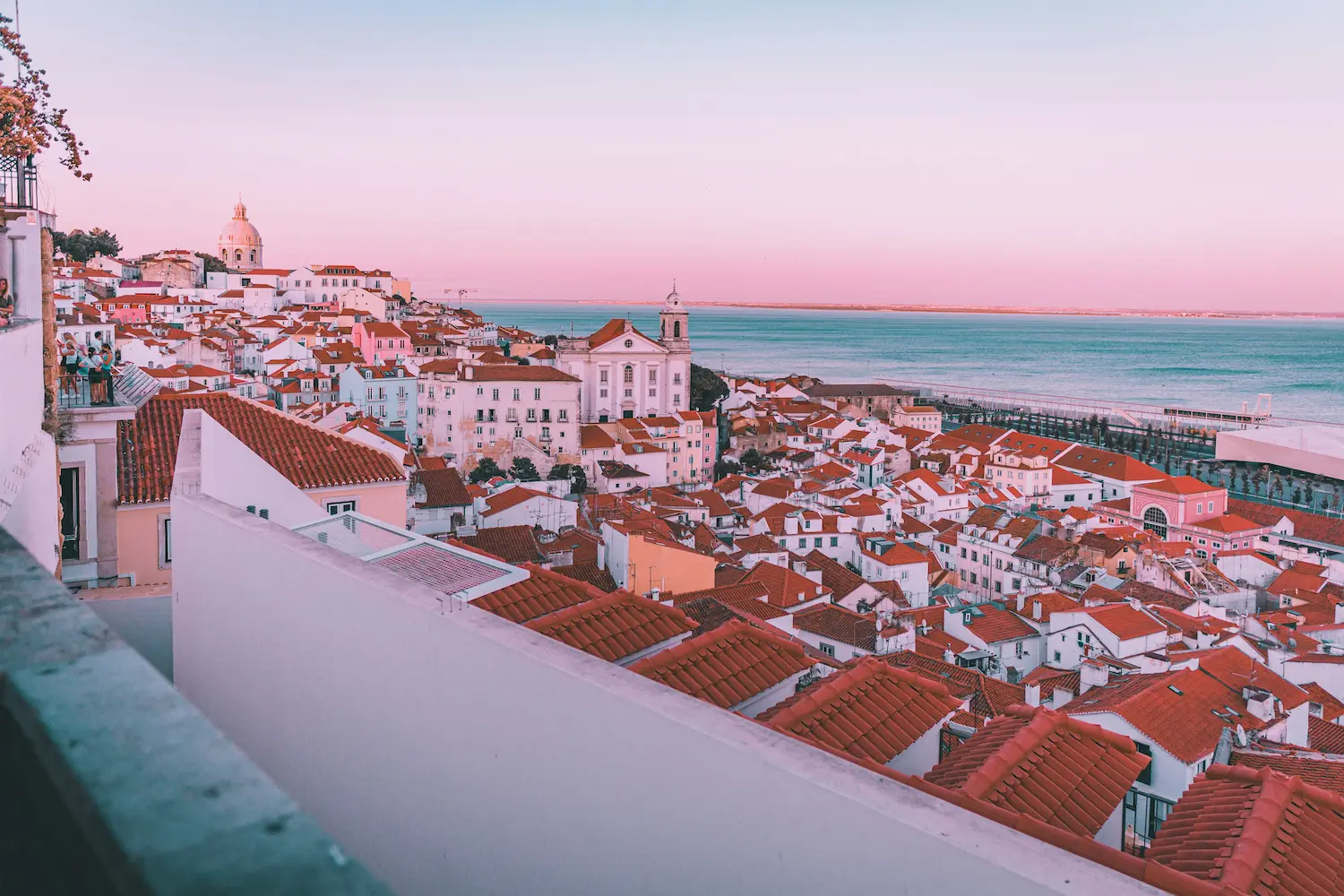
There are two ways to visit Alfama.
The first is to arrive with a list. Sé Cathedral. Castelo de São Jorge. Portas do Sol. Santa Luzia. Fado Museum. Photograph. Tick. Next.
The second is to put the list somewhere deep inside your bag, forget where you put it, and start walking.
The second one is better.
Because Alfama is not really a collection of attractions. It is a neighbourhood that happens to contain some of Lisbon’s most famous landmarks. Its real attraction is the neighbourhood itself: staircases that seem to have been designed by someone with a personal grudge against your calves, tiny squares appearing between buildings, laundry hanging above your head, tiled façades catching the morning light, elderly neighbours chatting from windows and the occasional glimpse of the Tagus appearing at the end of a street like a reward.
Alfama is Lisbon at its most labyrinthine, historic and wonderfully inconvenient.
It is also one of the best places to understand why Lisbon feels the way it does.
If you’re looking for things to do in Alfama, start with the obvious landmarks. Then deliberately get lost between them.
Alfama is one of Lisbon’s oldest and most traditional neighbourhoods, occupying the hillside between the Tagus and São Jorge Castle.
The name is generally associated with the Arabic al-hamma, referring to baths or springs, a reminder of the neighbourhood’s connection with Lisbon’s Islamic past.
But Alfama’s story is considerably older and more complicated than a simple Moorish footnote. Romans, Visigoths, Muslims, Christians, merchants, sailors, fishermen, workers and artists have all left traces here.
That layered history is one of Alfama’s greatest charms.
You don’t necessarily see it in a grand museum. You see it in the street plan.
Alfama’s narrow lanes and irregular staircases feel completely different from the broad, geometric streets of Baixa. While the Baixa was largely rebuilt according to a planned grid after the 1755 earthquake, Alfama retained much of its older urban fabric.
Which means that, centuries later, you can still walk through streets that feel like they were drawn by someone who had never heard of a ruler.
Lisbon’s 1755 earthquake destroyed enormous parts of the city. The subsequent tsunami and fires made the disaster even more devastating.
Yet Alfama was comparatively less affected than many areas farther west.
Its position on the hillside and the geological characteristics of the area helped protect parts of the neighbourhood, while its older, irregular urban fabric survived to a significant degree.
That is why walking through Alfama can feel like moving between different versions of Lisbon.
At the bottom of the hill, you have the waterfront and the reconstructed Baixa.
A few minutes uphill, the city suddenly becomes medieval-looking again.
There is no time machine involved.
Just some very old streets that stubbornly refused to disappear.
This is the important bit.
Don’t try to explore Alfama as efficiently as possible.
You will fail anyway.
The neighbourhood climbs from the Tagus towards São Jorge Castle, and its streets twist around the hillside rather than following a neat grid. Narrow lanes become staircases. Staircases become little squares. Little squares become another staircase.
Occasionally, a street simply stops.
This isn’t bad urban planning.
Well, technically it probably is.
But it is excellent wandering territory.
For a first visit, start at the Sé Cathedral and use the major landmarks as anchors rather than following a rigid route. Walk uphill towards Santa Luzia, continue to Portas do Sol, then head towards Castelo de São Jorge.
Once you’ve seen the big sights, start taking the smaller streets.
Rua de São Miguel is a particularly good example of the Alfama experience. So is the area around Rua dos Remédios, where the neighbourhood gradually becomes more residential as you move towards Santa Apolónia.
The trick is to alternate between orientation and wandering.
Find a viewpoint.
Get your bearings.
Choose a street that looks interesting.
Walk it.
Eventually find another landmark.
Repeat.
Google Maps will tell you where you are. Alfama will occasionally make you question why you are there.
Both systems can coexist.
And don’t be afraid of getting lost. Alfama is small enough that, sooner or later, you’ll reach a recognisable street, a viewpoint, the river or a staircase that looks suspiciously familiar.
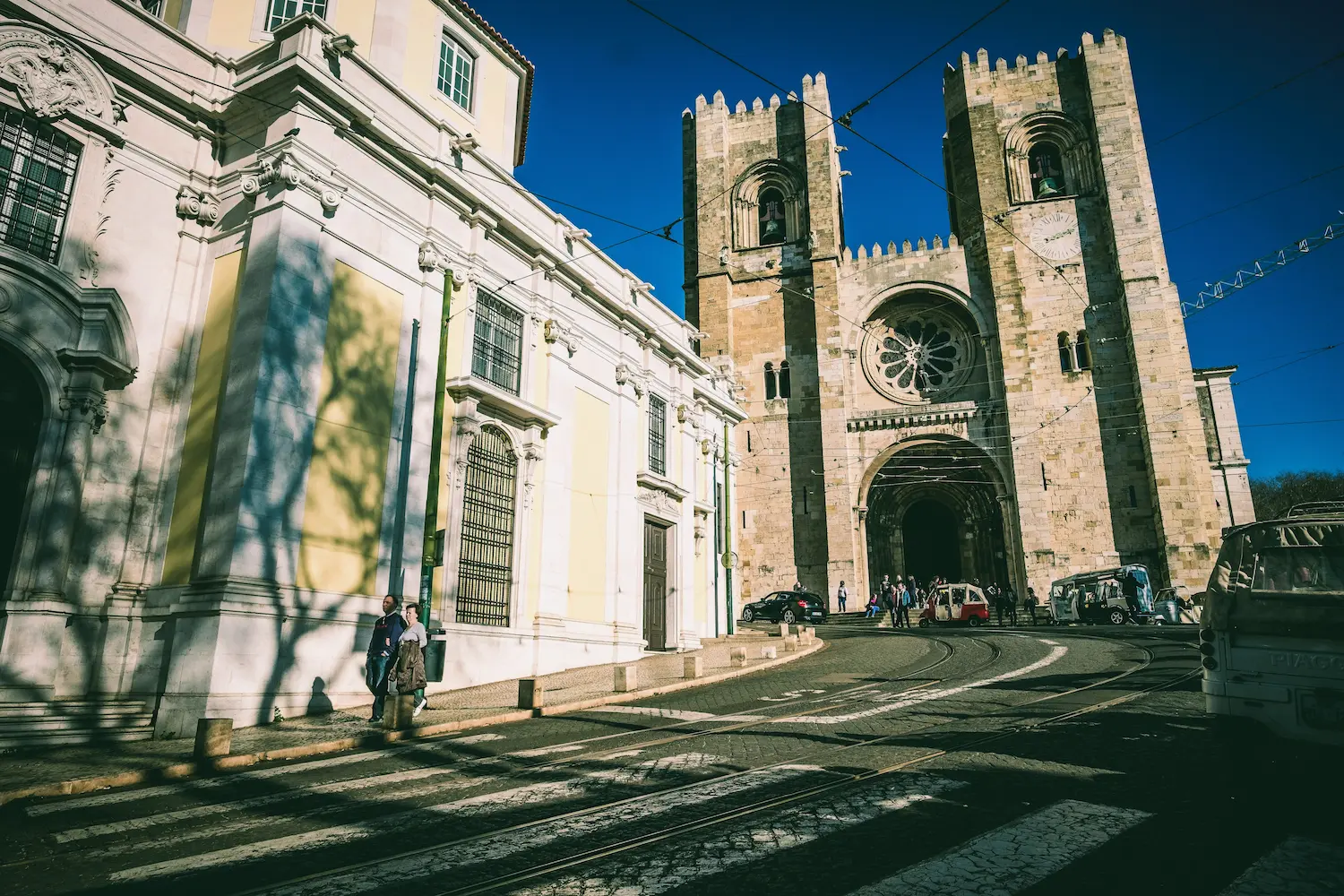
Start around the Sé de Lisboa, Lisbon’s cathedral and one of Alfama’s most recognisable landmarks.
Construction began in the 12th century after the Christian conquest of Lisbon, and the building has been altered and restored repeatedly over the centuries.
The result is a wonderfully complicated architectural mixture.
The heavy Romanesque exterior gives the cathedral its fortress-like appearance, while later additions reveal different periods of Lisbon’s history.
The Sé is also a useful geographical marker.
From here, Alfama begins climbing.
And climbing.
This is your first opportunity to understand that the word “walking tour” has a slightly different meaning in Lisbon.
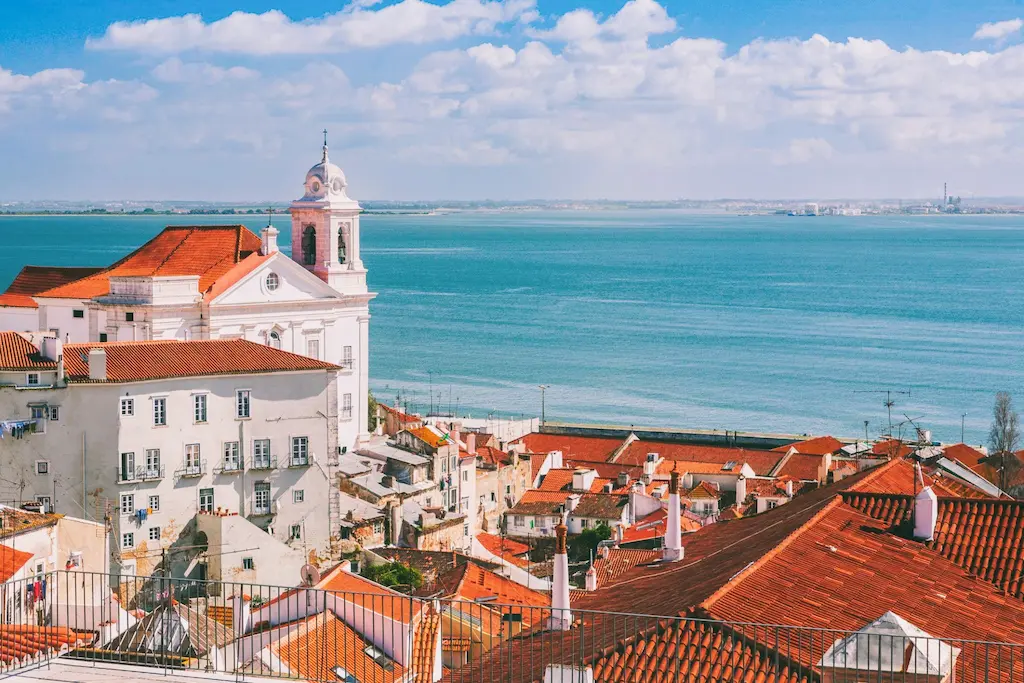
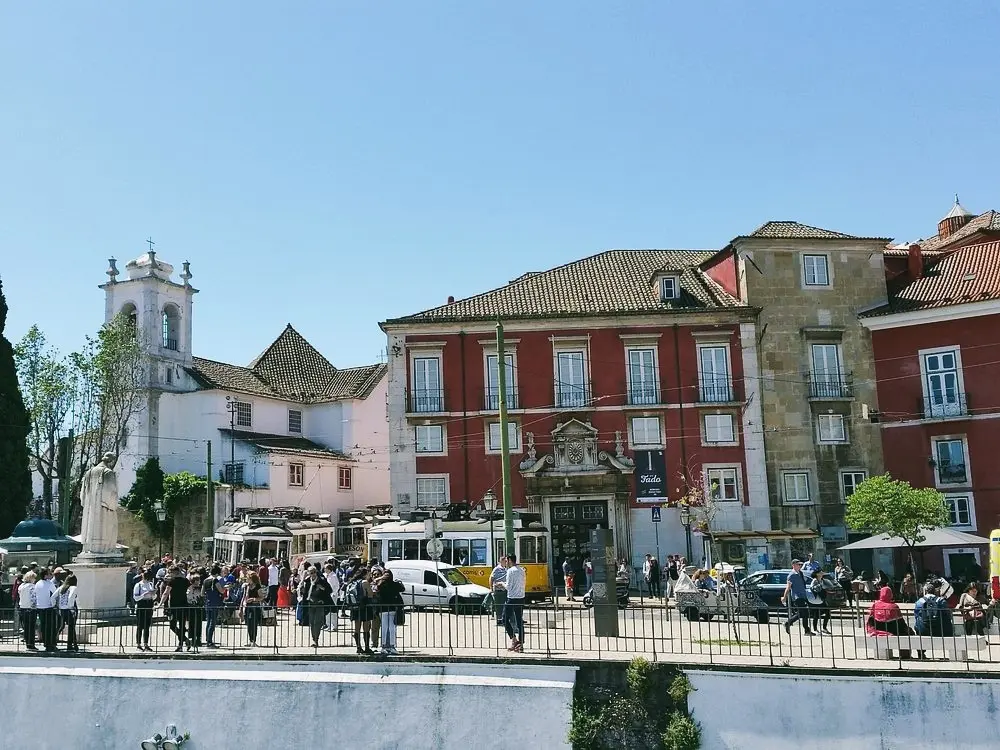
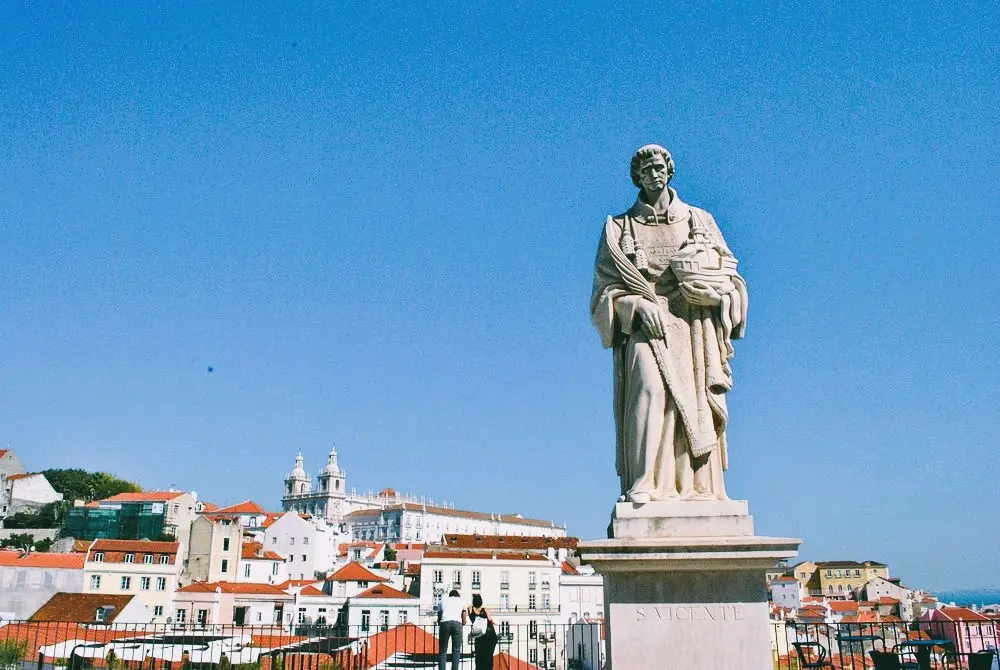
Continue uphill and you’ll reach the Miradouro de Santa Luzia, one of the most famous viewpoints in Alfama.
The view opens towards the Tagus, with Alfama’s rooftops cascading down the hillside towards the water.
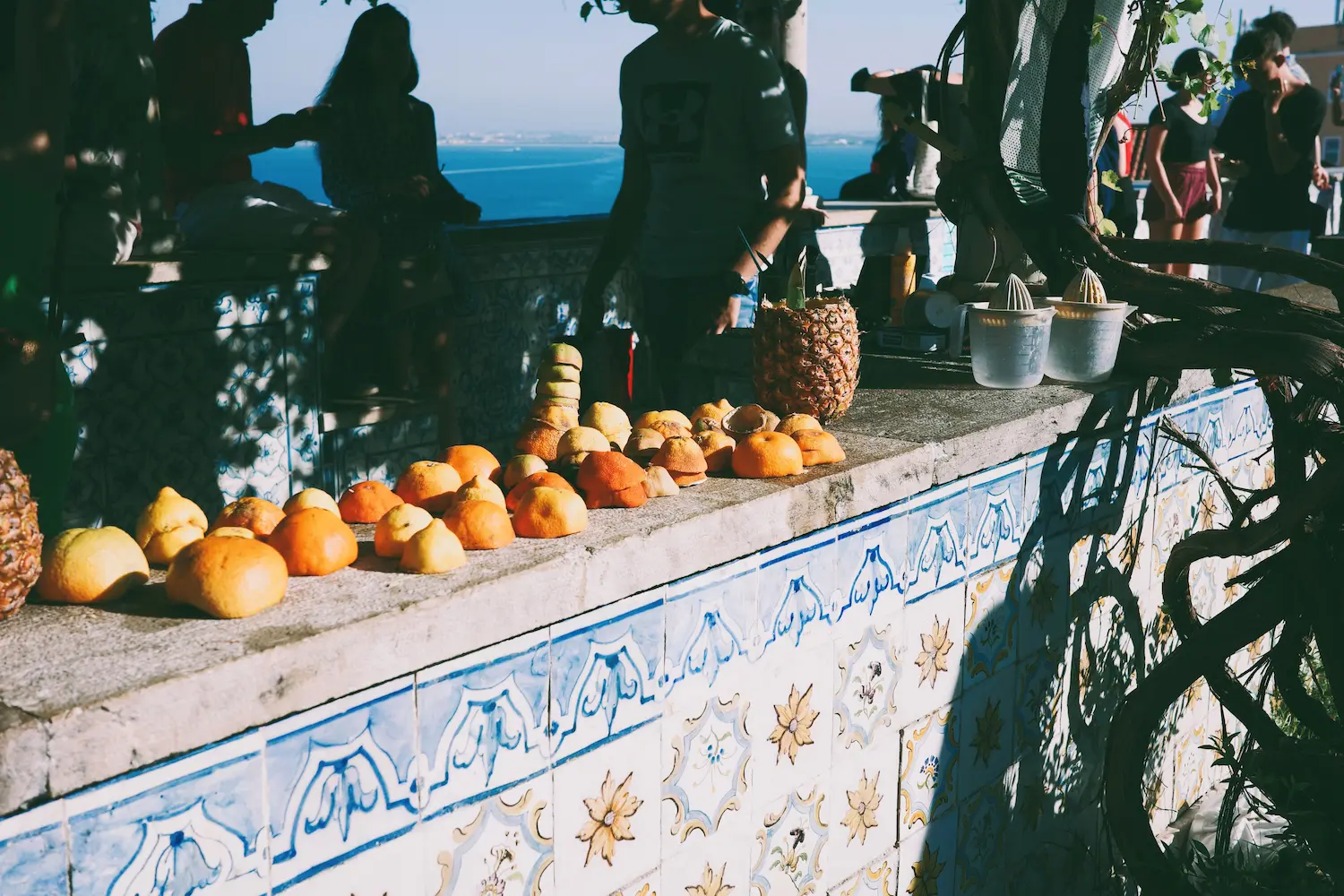
The viewpoint sits beside the Igreja de Santa Luzia and is particularly beautiful because of its azulejo decoration.
This is classic Lisbon.
White façades. Terracotta roofs. Blue tiles. The river beyond.
And, during peak hours, a small international convention of people attempting to take exactly the same photograph.
Visit early in the morning if you want the quietest experience.
Come later if you prefer atmosphere and people-watching.
Both work.
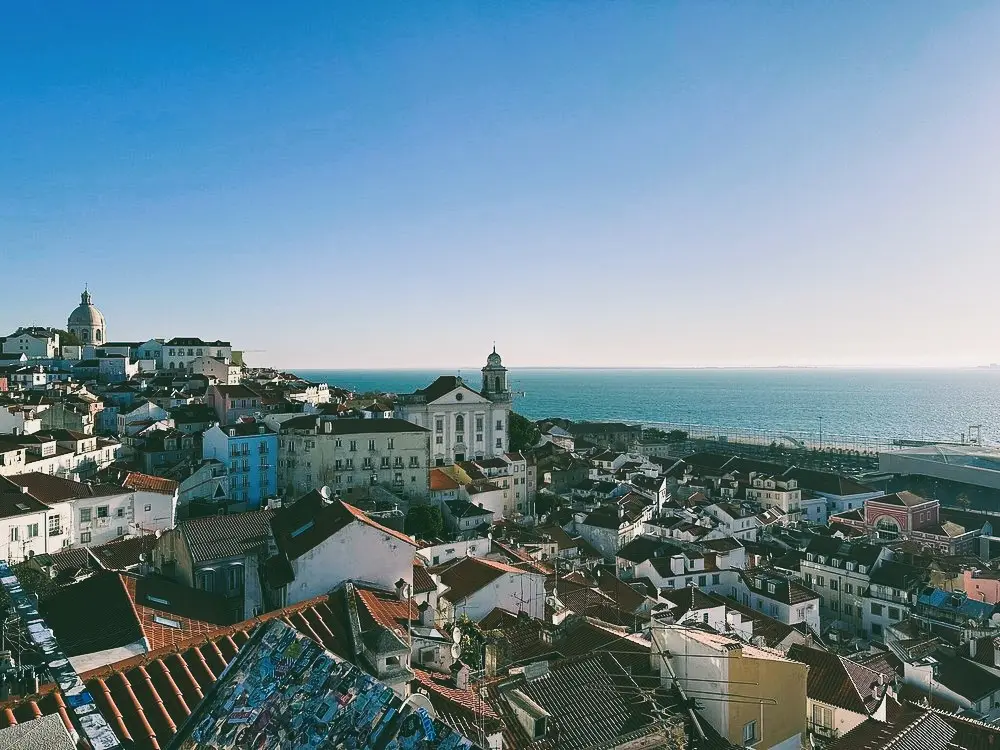
A few steps farther uphill is Miradouro das Portas do Sol, the “Gates of the Sun”.
The panorama here is broader, taking in Alfama, the Tagus and several of the neighbourhood’s major monuments.
You can spot the dome of the National Pantheon and the towers of São Vicente de Fora among the rooftops.
Portas do Sol is also one of the busiest viewpoints in Alfama, so don’t expect a private balcony over Lisbon.
Instead, use it as a pause.
Sit down.
Have a coffee.
Look at the city.
Then leave the viewpoint and disappear into the streets again.
That’s the trick with Alfama.
The famous places are useful landmarks.
The spaces between them are often more interesting.
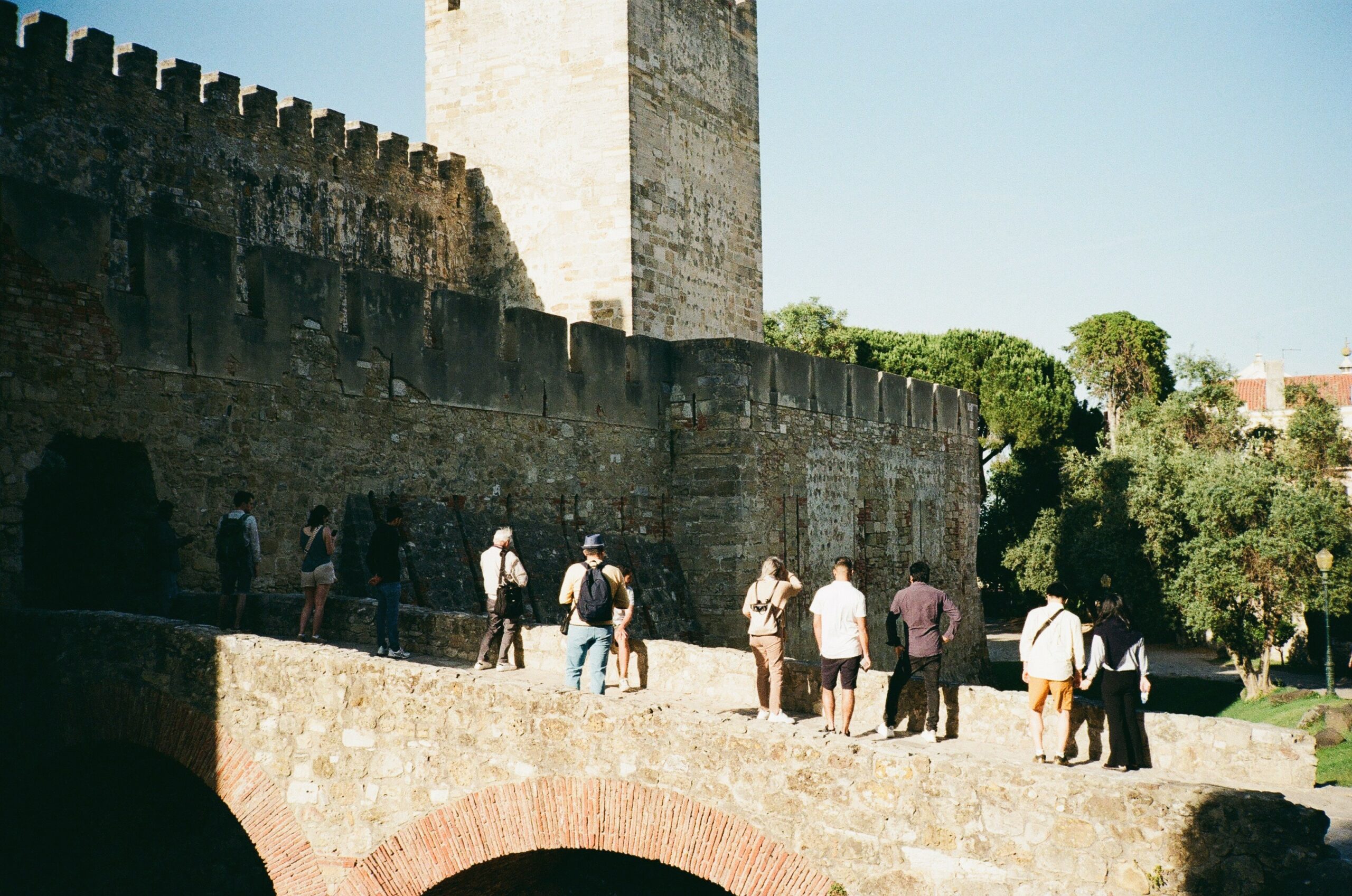
At the top of Alfama sits Castelo de São Jorge, one of Lisbon’s essential landmarks.
The castle occupies a strategic hilltop position overlooking the city and the Tagus. Its history stretches through several periods, including Lisbon’s Islamic era and the Christian conquest.
Today, visitors come for the archaeological remains, gardens, castle walls, towers and museum, but the views are arguably the main event.
From the castle, Lisbon unfolds below you almost like a map: Alfama’s rooftops, Baixa’s grid, the river and the city stretching beyond it.
The castle is currently open daily. From March to October, it opens from 9am to 9pm, with last admission at 8:30pm. From November to February, it closes at 6pm, with last admission at 5:30pm. Adult admission is currently €17.
Official Castelo de São Jorge visitor information
If you visit during the warmer months, going earlier in the day can make the experience considerably more pleasant.
And if you want a little more history with your walls, the castle ticket currently includes a guided “Discovering the Castle” tour, subject to capacity and weather conditions.
Alfama is one of Lisbon’s best neighbourhoods for viewpoints because, well, it is essentially one large hill with excellent marketing.
The most famous viewpoints are easy to remember.
Santa Luzia is the romantic one, with azulejos, the church and the classic view over the rooftops and Tagus.
Portas do Sol gives you a wider panorama and is excellent for watching the neighbourhood move around you.
Castelo de São Jorge provides the grandest perspective, looking well beyond Alfama towards the rest of Lisbon.
But don’t stop there.
One of the pleasures of exploring Alfama is discovering unofficial viewpoints. A staircase may suddenly open towards the river. A small street may reveal a gap between buildings where the city stretches out below you.
These views don’t have a name.
That’s rather the point.
If you’re photographing Alfama, early morning and late afternoon are particularly rewarding. The changing light catches the tiled façades and rooftops beautifully, while the softer light makes the white buildings considerably less aggressive to your camera sensor.
Then there is Fado.
You can’t really talk about Alfama without talking about Fado, although it is worth avoiding the slightly lazy idea that every corner of the neighbourhood spontaneously starts singing melancholy Portuguese songs at sunset.
It doesn’t.
Fado is a musical tradition deeply associated with Lisbon and its historic neighbourhoods. Alfama became particularly connected with it through its working-class and maritime communities.
The music is difficult to translate neatly.
There is longing in it. Saudade. Love, loss, memory, the sea and everyday life.
And sometimes what sounds like profound emotional suffering is actually someone singing about something considerably more ordinary.
Which is very human, really.
Fado was inscribed on UNESCO’s Representative List of the Intangible Cultural Heritage of Humanity in 2011. The Museu do Fado itself continues to document and promote the tradition from its home in Alfama.
The Museu do Fado sits at Largo do Chafariz de Dentro, right in the heart of Alfama.
It is the place to go if you want to understand Fado before simply ordering dinner somewhere that happens to have a Portuguese guitar in the corner.
The museum explores the history and development of Fado through exhibitions, collections and recordings.
It is currently open Tuesday to Sunday from 10am to 6pm, with last admission at 5:30pm. A normal adult ticket is €5.
Museu do Fado official website
The museum also runs cultural programmes and live Fado-related events. Its 2026 calendar includes the “Visitas Cantadas”, combining a museum visit with live Fado performances from artists associated with Alfama’s Fado houses.
That’s particularly interesting if you happen to be visiting when one of these programmes is taking place.
This is where you should stop treating Alfama like an open-air museum.
People live here.
People also eat here.
And thankfully, there is considerably more on offer than a €17 tourist menu featuring cod and a suspiciously enthusiastic sangria.
For a traditional Portuguese meal, the streets around Rua dos Remédios and Largo do Chafariz de Dentro are a good place to start.
Antù Alfama is one current option around Beco de São Miguel, while Barracão de Alfama offers a smaller restaurant experience around Rua de São Pedro.
For something more casual, Tasca do Sr. Matos is tucked into Escolas Gerais and works well for a less ceremonious stop.
If you are looking for something later in the day, The Corkscrew Wine bar on Rua dos Remédios is a useful option for wine and small bites, while Outro Lado Craft Beer offers a more modern alternative to the traditional Lisbon drinking experience.
And yes, there are brunch places too.
Lisbon has apparently decided that no neighbourhood is allowed to escape brunch.
The more distinctive Alfama dinner experience is, naturally, Fado.
This is where you need to understand what you’re booking.
A Fado house is not simply a restaurant with music playing in the background.
When the singer performs, the room generally becomes quiet. Conversations stop. Plates become temporarily secondary. The music takes over.
That is part of the experience.
One of Alfama’s historic names is Parreirinha de Alfama, whose history as a Fado and dining venue goes back to 1939. Its current programme continues the tradition of combining Portuguese cuisine with Fado.
Clube de Fado is another established option, just a few steps from the Sé. It currently opens every evening from 7:30pm, with Fado performances from 8:30pm.
Further down Rua dos Remédios, Mesa de Frades offers a particularly atmospheric setting inside an 18th-century chapel. The venue’s own history describes its transformation from chapel to charcoal warehouse and tavern before becoming a Fado venue.
You can also find current Fado venues such as Sr. Fado and Adega de Alfama around the neighbourhood.
The important thing is to research the current programme and booking conditions rather than choosing solely because a website somewhere declared a restaurant “authentic” in 2017.
Authenticity has a surprisingly long shelf life on travel websites.
After the castle and viewpoints, walk back down towards Rua dos Remédios.
This is where Alfama becomes less about monuments and more about neighbourhood life.
Rua dos Remédios runs through the lower part of Alfama towards Santa Apolónia. Along the way you’ll find restaurants, bars, cafés, small shops and plenty of architectural details.
Look up.
Seriously.
Lisbon has a habit of putting interesting things above eye level.
Balconies. Façades. Tiles. Old signs. Laundry. Plants growing out of improbable places.
Alfama is particularly good for this because the streets are narrow enough that the buildings constantly interact with each other.
It is a neighbourhood built vertically.
People live above shops.
Windows look across alleys.
Staircases become streets.
And the Tagus keeps appearing between buildings.
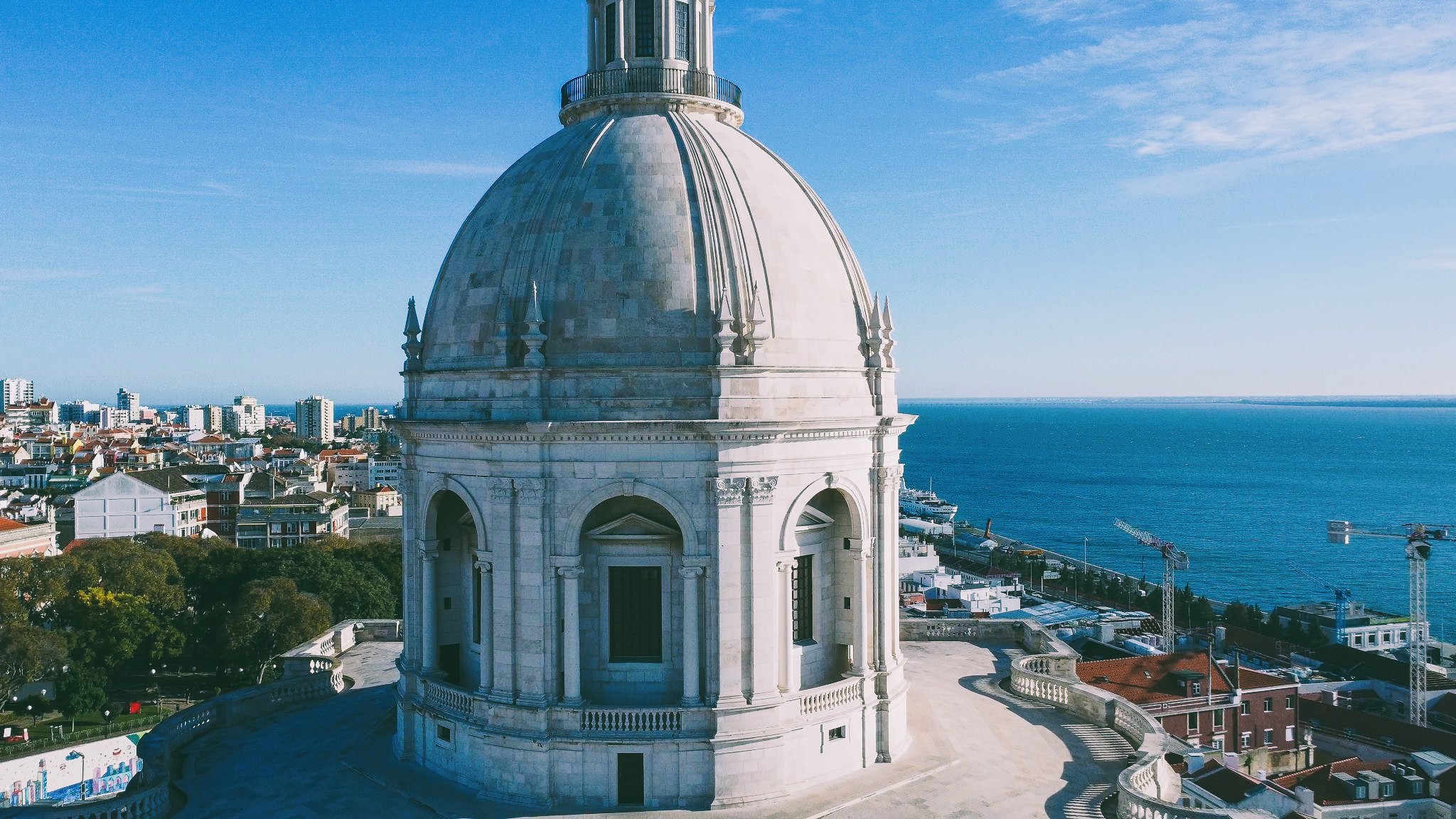
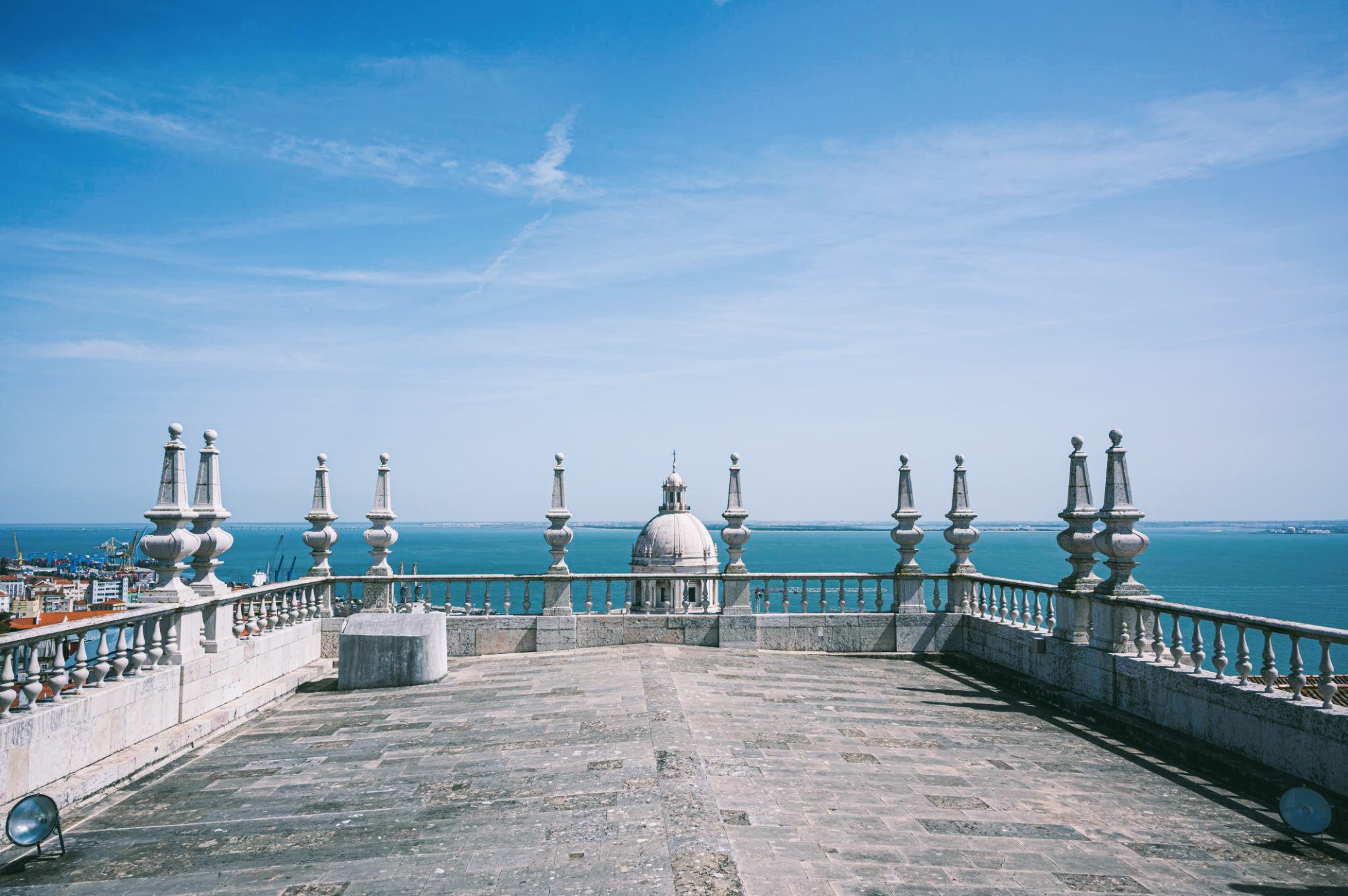
The Panteão Nacional, or National Pantheon, is another major landmark on the eastern side of Alfama.
Its enormous white dome is one of the easiest architectural markers to spot from the viewpoints.
The building began life as the Church of Santa Engrácia, a project whose construction became so famously prolonged that the Portuguese expression “works of Santa Engrácia” became associated with something taking an absurdly long time.
So yes.
Even Portuguese architecture has a project-management joke.
Inside, the monumental space contains tombs and memorials dedicated to important figures in Portuguese history and culture.
The rooftop terrace also offers another perspective over Alfama and the Tagus.
It’s worth considering as part of a longer walk rather than treating it as an isolated attraction.
Continue uphill and you’ll reach the Igreja e Mosteiro de São Vicente de Fora.
The monumental complex sits just beyond the densest part of Alfama and is one of the neighbourhood’s architectural heavyweights.
Its church and monastery are particularly notable for their azulejo decoration.
This is one of those places that can easily disappear from a visitor’s itinerary because Lisbon has too many beautiful buildings competing for attention.
That’s a slightly ridiculous problem to have.
If you have the time, go inside.
Alfama is steep.
Not “there is a gentle incline” steep.
Actual Lisbon steep.
If you’re planning a three-hour walk, don’t calculate it purely by kilometres. A kilometre through Alfama can require considerably more effort than the same distance on flat ground.
Take breaks.
There is no prize for reaching the castle looking like you’ve just completed military training.
This one sounds obvious until you see someone trying to descend an Alfama staircase in completely flat leather sandals.
The pavement is often calçada portuguesa, the traditional small-stone paving used throughout Lisbon. It is beautiful, historic and occasionally determined to test your ankle stability.
Comfortable shoes with a decent grip are your friends.
Your feet will remember this advice later.
The calçada is part of Lisbon’s visual identity, but it can be slippery, especially after rain.
Watch your step on steep sections and uneven surfaces.
If you’re carrying luggage, don’t choose Alfama as your grand entrance route unless you have a very good reason.
Wheels and Portuguese cobblestones have a complicated relationship.
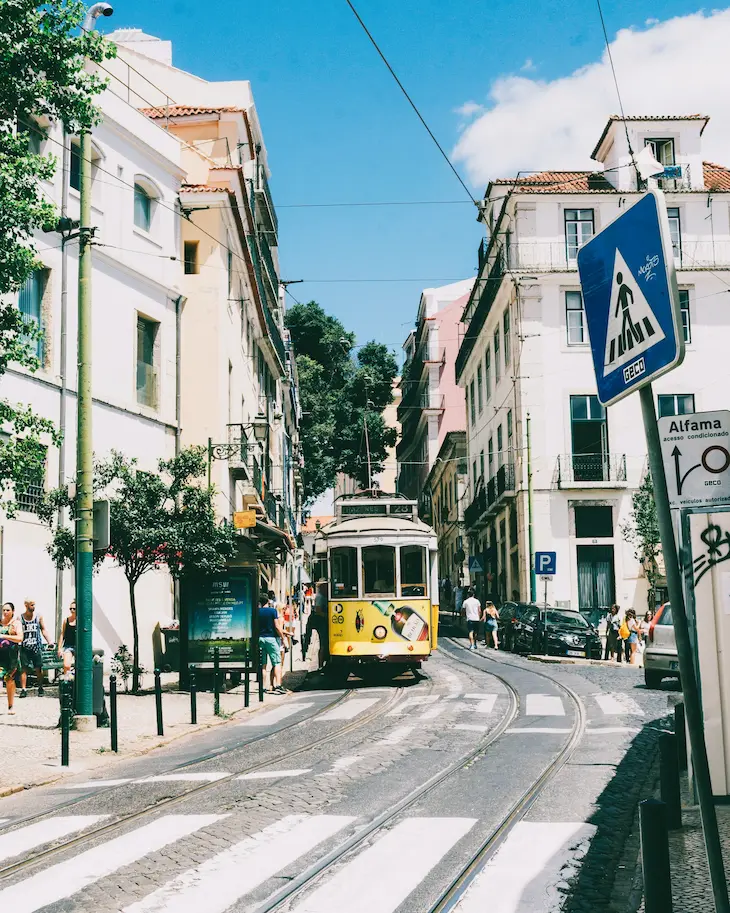
The famous Tram 28 passes through the historic neighbourhoods of Lisbon and is one of the city’s classic experiences.
It also gets very crowded.
The traditional route climbs through areas including Alfama and passes major sights such as the Sé and Portas do Sol. Visit Lisboa’s own Fado route describes the historic tram as a way to experience Lisbon’s older neighbourhoods, including Alfama.
The temptation is to use Tram 28 as your Alfama walking tour.
Don’t.
Use it as transportation or as an experience in its own right, but explore Alfama on foot once you’re there.
The tram cannot turn into a tiny staircase.
It has tried.
If you really want to ride it, consider starting from a stop farther down the route rather than assuming you’ll simply walk up to the most popular stop and board immediately.
Crowds vary, and operating conditions can change.
The best way to experience Alfama is still to walk.
The tram is the garnish.
The busiest areas around Santa Luzia, Portas do Sol and the castle can become very crowded during the middle of the day.
Early morning is excellent for quieter streets and photography.
Late afternoon is good for softer light and viewpoints.
Evening is when the Fado side of Alfama becomes particularly interesting.
If you want to photograph the neighbourhood without having a stranger’s elbow permanently occupying the foreground, morning is your friend.
This matters.
The laundry isn’t decoration.
The balconies aren’t props.
The narrow streets aren’t a theme park.
People live here.
Keep your voice down around residential streets, don’t block doorways, and be considerate when photographing people or private homes.
The more respectful you are, the more likely Alfama remains a neighbourhood rather than becoming another perfectly preserved stage set.
Alfama is not the easiest part of Lisbon for people with reduced mobility, wheelchairs or strollers.
There are steep gradients, stairs, narrow streets and uneven pavements.
That doesn’t mean the neighbourhood is inaccessible in every sense, but it does mean that a route needs to be planned carefully.
The lower streets around the Fado Museum and Santa Apolónia are generally easier than the upper maze around the castle.
If accessibility is important for your visit, don’t simply copy a generic “best of Alfama” walking route.
Give yourself at least half a day.
Two hours is enough for a quick introduction: Sé, Santa Luzia, Portas do Sol and some wandering.
Three to four hours gives you a much better first experience, with time for the castle and a proper look around the streets.
A full day lets you slow down, visit the Fado Museum, explore the National Pantheon and São Vicente de Fora, stop for lunch and spend some time in the neighbourhood rather than constantly moving between attractions.
An evening is worth adding if Fado interests you.
And if you’re staying in Lisbon for several days, don’t feel that you need to “finish” Alfama in one visit.
Come back in the morning.
Come back at sunset.
Come back at night.
The neighbourhood changes with the light.
For a first visit, this is the route we’d recommend.
Start at Sé Cathedral in the morning.
Walk uphill through the smaller streets towards Santa Luzia and stop at the viewpoint.
Continue to Portas do Sol. Take your time here, but don’t linger simply because every guide says you should.
From there, make your way towards Castelo de São Jorge. Visit the castle if history and panoramic views are your thing.
Then descend slowly.
Don’t take the most direct route.
Walk towards Largo do Chafariz de Dentro and visit the Museu do Fado if you have time.
Continue along Rua dos Remédios, stopping for lunch, coffee or a glass of wine.
If you still have legs, head towards the National Pantheon and São Vicente de Fora.
If you don’t, congratulations.
You have discovered the correct Lisbon travel philosophy.
Sit down.
Eat something.
The city will still be there.
For an evening continuation, book a Fado house and let the neighbourhood change character around you.
Yes.
But don’t visit Alfama expecting a polished historic district where everything has been arranged for your convenience.
That’s precisely what makes it interesting.
Alfama is uneven, steep, crowded in places, quiet in others, touristy around the major landmarks and still residential beyond them.
It can feel charming and frustrating within the same five minutes.
That’s Alfama.
If you want Lisbon’s major monuments neatly arranged along wide pedestrian streets, there are other parts of the city for that.
If you want to understand the older city, walk its hills and see how Lisbon grew rather than how it was redesigned, Alfama should be high on your list.
There is a temptation to romanticise Alfama.
And honestly, it deserves some of it.
But the neighbourhood becomes more interesting when you look beyond the postcard.
Alfama is not just yellow trams, tiled façades and Fado.
It is also ageing buildings, tourism pressure, residents dealing with the realities of living in one of Lisbon’s most visited neighbourhoods, narrow streets that make everyday logistics complicated and a community trying to remain a community while becoming one of the city’s most photographed places.
That tension is part of modern Alfama too.
The best visitor experience is therefore not to pretend you’re discovering some untouched medieval village.
You’re not.
You’re visiting a living part of Lisbon.
And the more respectfully you explore it, the more interesting it becomes.